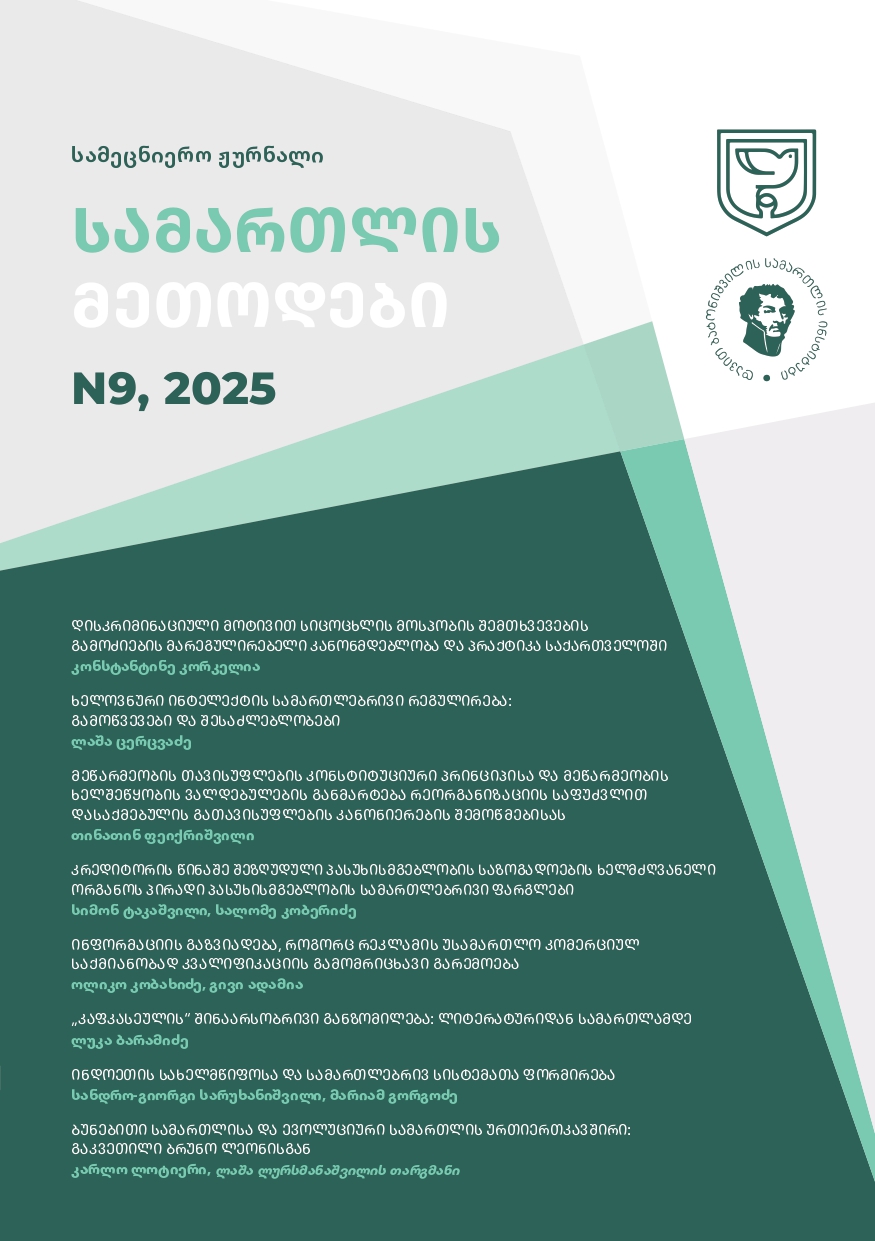
„ᲙᲐᲤᲙᲐᲡᲔᲣᲚᲘᲡ“ ᲨᲘᲜᲐᲐᲠᲡᲝᲑᲠᲘᲕᲘ ᲒᲐᲜᲖᲝᲛᲘᲚᲔᲑᲐ: ᲚᲘᲢᲔᲠᲐᲢᲣᲠᲘᲓᲐᲜ ᲡᲐᲛᲐᲠᲗᲚᲐᲛᲓᲔ
DOI:
https://doi.org/10.63410/20251204/06საკვანძო სიტყვები:
Kafkaesque, Law and Literature, Der Process, Kafkaანოტაცია
The paper examines the semantic and functional transformation of the term “Kafkaesque,” tracing its evolution from a literary concept into a notion applicable within the legal field. It treats this transformation as a natural development and explores the connections between literature and law, framing the study as an interdisciplinary inquiry. The research focuses on the potential of literary narratives to critically illuminate legal reality. In this context, “Kafkaesque” is not merely a metaphor for describing legal absurdity but a powerful tool for critiquing systems of justice and a standard for their evaluation. The term reveals the
dehumanizing tendencies within existing judicial structures and indicates pathways for their rehumanization.
Downloads
წყაროები
Dorf M. C., The Supreme Court’s Most Kafkaesque Decision: Penalizing a Criminal Defendant for Relying on a Court’s Official
Statement of the Due Date for His Habeas Corpus Appeal, 2007, <https://supreme.findlaw.com/legal-commentary/the-supremecourts-most-kafkaesque-decision-penalizing-a-criminal-defendan for-relying-on-a-courts-official-statement-of-the-due-date-for-his-habeas-corpus-appeal.html> [30.08.2025]
Edwards I., The Essence of “Kafkaesque”, The New York Times, 1991, 1. <http://www.nytimes.com/1991/12/29/nyregion/the-essenceof-kafkaesque.html?pagewanted=all> [22.08.2025]
• Figueiredo De Oliveira R. H., Kafka as a Criminalist: From Literary Fiction to Criminal Ceality, Translated by F. Zobaran, Revista
Internacional de Direito e Literatura Vol. 3, No. 2, 2017
• Finet S., Franz Kafka’s Trial as Symbol in Judicial Opinions, Legal Studies Forum, Vol. 12, No. 1, 1988
• Flood A., Kafkaesque: A Word so Overused It Has Lost All Meaning?, 2016, <https://www.theguardian.com/books/booksblog/2016/
may/18/kafkaesque-a-word-so-overused-it-has-lost-all-meaning> [22.08.2025]
• Kokott J., Sobotta Chr., The Kadi Case – Constitutional Core Values and International Law – Finding the Balance?, The European Journal
of International Law, Vol. 23, No. 4, 2012
• Ley I., Legal Protection against the UN-Security Council between European and International Law: A Kafkaesque Situation?, German
Law Journal, Vol. 8, No. 6, 2006
• Martinico G., The Autonomy of EU Law: A Joint Celebration of Kadi II and Van Gend en Loos, in: Kadi on Trial, A Multifaceted Analysis
of the Kadi Trial, Edited by M. Avbelj, F. Fontanelli, G. Martinico, Routledge Taylor and Francis Group, London and New York, 2014
• Mason L., The Intractably Unknowable Nature of Law: Kadi, Kafka and the Law’s Competing Claims to Authority, Routledge, 2014
• Posner R., Law and Literature, 3rd Ed., Harvard University Press, 2009
• Potter P. B Jr., Ordeal by Trial: Judicial References to the Nightmare World of Franz Kafka, The University of New Hampshire Law Review,
Vol. 3, No. 2, 2005
• Teubner G., The Law before Its law: Franz Kafka on the (Im)possibility of Law’s Self-reflection, Cambridge University Press, 2019
ჩამოტვირთვები
გამოქვეყნებული
როგორ უნდა ციტირება
გამოცემა
სექცია
ლიცენზია
საავტორო უფლებები (c) 2025 LUKA BARAMIDZE

ეს ნამუშევარი ლიცენზირებულია Creative Commons Attribution-ShareAlike 4.0 საერთაშორისო ლიცენზიით .